
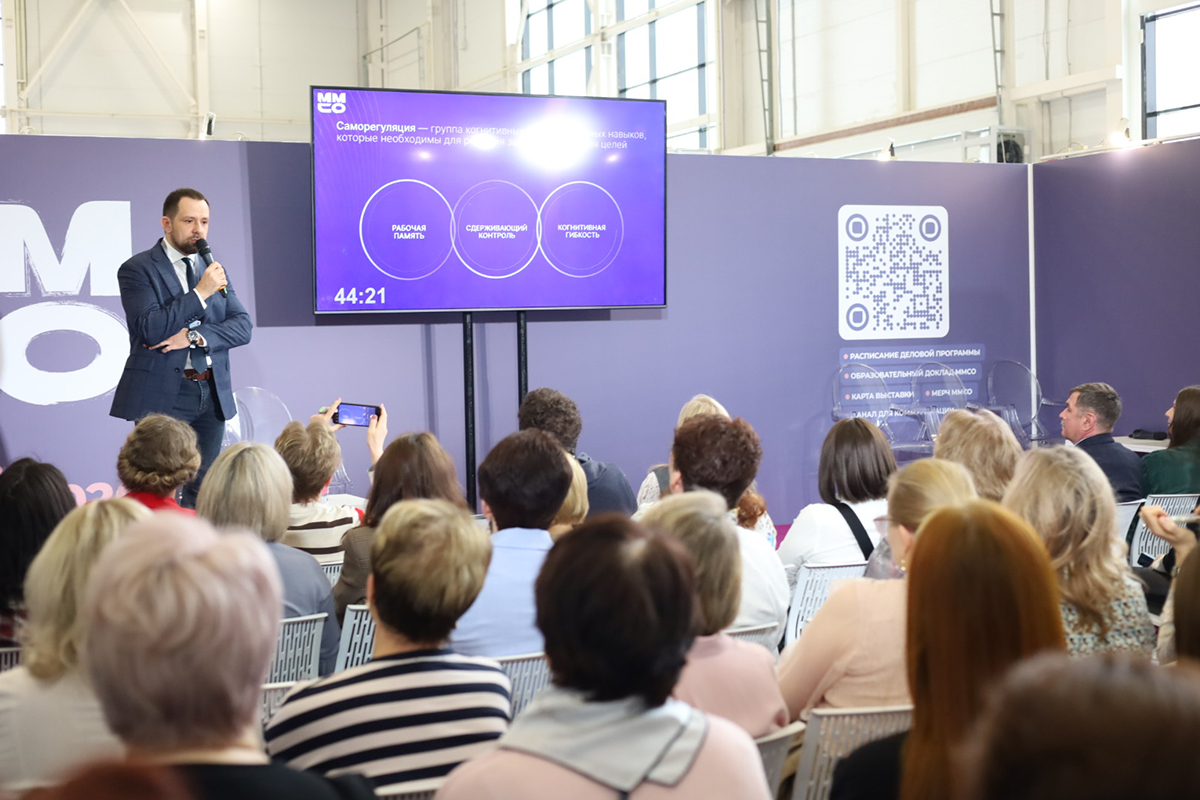
The event gathered a broad audience of educators, psychologists, child development researchers, and parents, and was dedicated to presenting the key findings of the large-scale longitudinal project "Rastem Vmeste" ("Growing Together").
In an era of rapid technological progress, when practitioners and families face new challenges in upbringing and education every day, it is especially valuable to rely not on fleeting trends but on data from representative scientific studies conducted in a rigorous evidence-based manner.
The speaker was our colleague from the UNESCO Chair, Alexander Veraksa, Academician of the Russian Academy of Education, Head of the Department of Educational Psychology and Pedagogy at the Faculty of Psychology of Lomonosov Moscow State University, Vice-President of the Russian Psychological Society, Doctor of Psychological Sciences, and Professor.
The research is based on L.S. Vygotsky's cultural-historical approach. According to this approach, a child's mental functions are formed through key activities: play, communication, exploration, and productive activities. These provide cultural mediation of the psyche and lay the foundation for successful socialization and personal development.
Special attention in the project is paid to self-regulation – the ability to manage one's attention, memory, emotions, and behavior. Studies show that self-regulation skills for school adaptation are often more important than intelligence level. An exclusive focus on cognitive development is not always justified, since school life requires a much broader range of skills – from the ability to listen and follow rules to constructive conflict resolution.
«The development of self-regulation in preschool age lays the foundation not only for academic success but also for a child's social well-being,»,
— stated A.N. Veraksa
A separate part of the lecture was devoted to the impact of the digital environment on preschool development. Project data revealed a consistent negative correlation between screen time and key indicators of child development.
«We see a clear pattern: the more time a child spends in front of a screen, the lower their indicators of self-regulation, speech development, motor skills, and emotional intelligence. Essentially, we are talking about the formation of behavioral addiction»,
— the speaker warned.
At the same time, he made an important clarification: the harm comes not from the use of digital devices per se, but from passive content consumption in the absence of dialogue with an adult. Even educational programs, if watched without discussion and meaningful guidance, do not contribute to speech development or the formation of critical thinking.
Equally significant data were obtained from studying the play preferences of preschoolers. The vast majority of children preferred "trendy" toys with a rigidly fixed function – characters from popular cartoons, interactive toys with a single action algorithm. Blocks, construction sets, and other open-ended, multifunctional materials that require imagination and active meaning-making were chosen much less frequently. However, it was precisely the children who spontaneously preferred open-ended materials who demonstrated significantly higher levels of imagination and creativity in diagnostic tests.
From the perspective of self-regulation development, the most productive was not just any play, but specifically pretend play with the participation of an adult who acts not as a director but as a partner and organizer of the play space: helping children maintain rules, coordinate actions, and develop the plot without substituting for children's initiative.
The study also clarified the role of preschool education. Children entering kindergarten with low self-regulation scores, provided they are in a high-quality educational environment for a year, successfully catch up with their peers. The key factor here is the quality of interaction in the "teacher–child" dyad: timely feedback, well-organized activities, and a favorable emotional climate in the group. Children from groups with high-quality pedagogical interaction, as data showed, not only demonstrate better academic outcomes but are also more socially successful – they are more often chosen as play partners and are better at recognizing and understanding others' emotions.
The lecture concluded with a set of practical recommendations that can be adopted by both kindergartens and families:
1. A structured daily routine with clear, consistent rules promotes self-regulation: children from families with a predictable schedule demonstrate significantly higher levels of self-control.
2. The quality of time spent with a child matters more than the quantity: parental busyness per se does not correlate with a child's developmental level, whereas involvement in joint meaningful activities – reading, discussion, creative work, walks – plays a key role.
3. Cultural leisure – visiting theaters, museums, exhibitions – positively affects self-regulation development regardless of the family's socioeconomic status.
4. Music and sports activities make a significant contribution to speech and cognitive development, often outperforming narrowly focused school preparation in the form of mechanical drilling of counting and writing.
5. For developing emotional intelligence, special programs based on dialogue about feelings through discussion of literary works, paintings, cartoons, and real-life situations are effective.
About the project
The longitudinal project "Rastem Vmeste" is one of the largest and most representative studies in child psychology and pedagogy in the Russian Federation. The project is implemented under the scientific supervision of leading specialists from the Faculty of Psychology of Lomonosov Moscow State University and the Federal Scientific Center for Psychological and Interdisciplinary Research.
Tens of thousands of children from various regions of the Russian Federation participate in the study, ensuring high representativeness of the data and the possibility of extrapolating it to the national sample.
For specialists and parents, the "Rastem Vmeste" team has prepared open resources:
- video recordings of lectures and webinars;
- methodological materials and diagnostic tools;
- publications of research results in Russian and English.
The study results are published in peer-reviewed scientific journals, including the journal Preschool Education Today, and are also featured in publications by the project's partner – the publishing house "MOZAIKA-SINTEZ."